

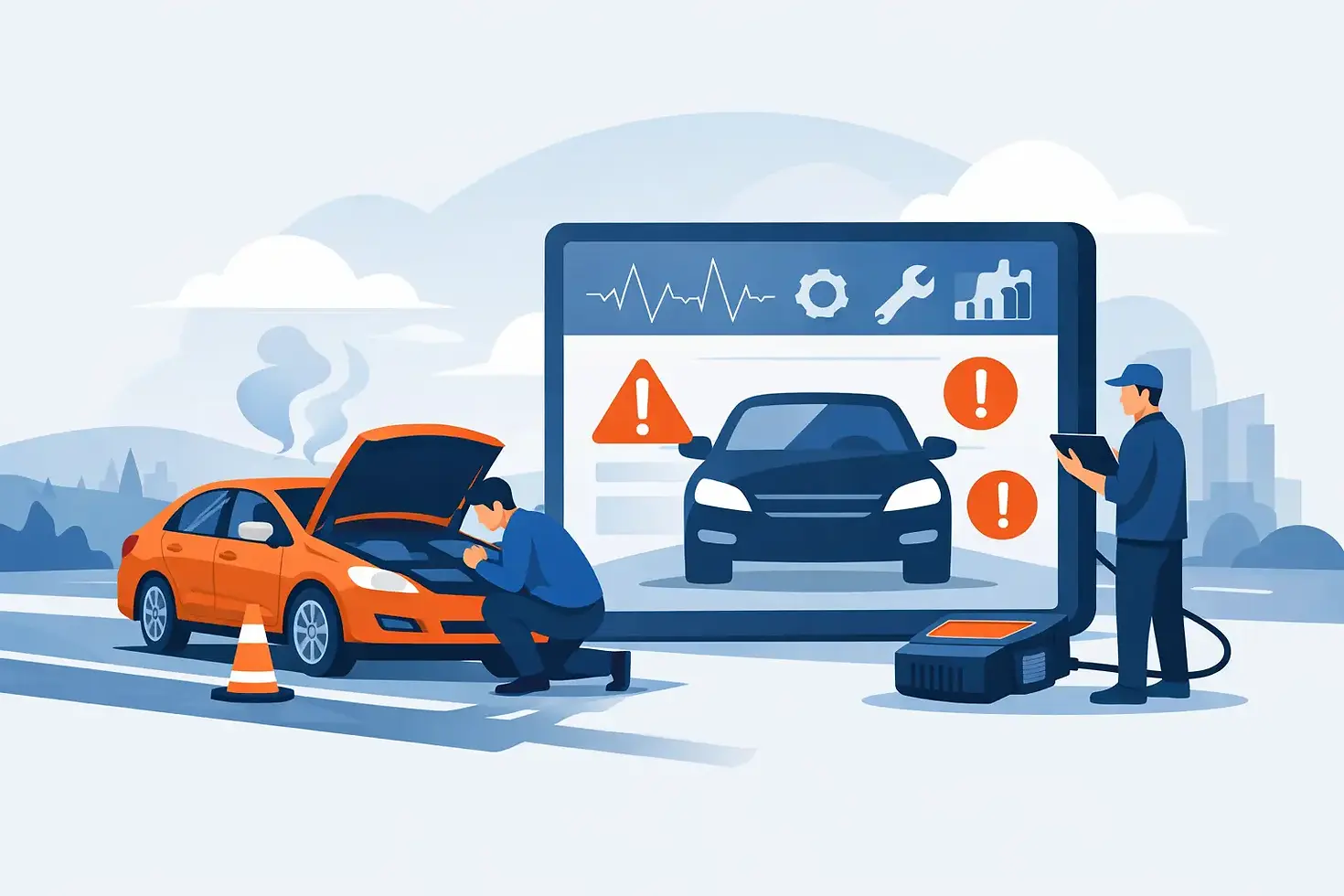
Vehicle Diagnostics: Why Your Car Stopped

A car that will not start in a parking garage or loses power in traffic rarely gives a simple answer. Vehicle diagnostics is the process of finding the actual cause before replacing parts, attempting repeated jumpstarts, or driving a car that may not be safe to drive. For a stranded driver, the goal is clear: identify what failed, make the right immediate decision, and get moving again safely.
A warning light, clicking sound, slow crank, overheating message, or sudden loss of electrical functions can point to several different faults. The battery may be flat, but it may also be failing because the alternator is not charging it. A no-start condition may involve the starter, fuel delivery, ignition, an immobilizer issue, or a damaged electrical connection. Proper testing separates a likely guess from a repair decision.
What Vehicle Diagnostics Can Tell You
Modern vehicles use onboard computers to monitor engine performance, emissions components, transmission behavior, battery charging, safety systems, and more. When a system detects an abnormal reading, it may store a diagnostic trouble code and turn on a warning light. Reading that code is useful, but it is only the start of the job.
For example, a code related to low battery voltage does not automatically mean a new battery is the answer. A technician should check battery condition, charging voltage, terminals, cables, and whether the vehicle has a drain when parked. Fitting a replacement battery without checking the charging system can leave the driver stranded again soon after.
The same principle applies to engine and transmission warnings. A code can identify the circuit or system reporting a problem, but the underlying reason may be a sensor, wiring fault, vacuum leak, worn component, fluid issue, or computer communication problem. Experienced diagnosis combines scan-tool data with physical inspection and targeted testing.
Common Problems That Need Testing
A few breakdown symptoms appear simple but can have more than one cause. Slow or repeated clicking during startup may be a weak battery, loose terminal, poor ground connection, failing starter, or a charging issue that drained the battery earlier. Headlights that dim while driving can suggest alternator trouble, but corroded cables and battery faults must also be ruled out.
An illuminated check engine light may be minor enough for a careful trip to a workshop, or it may signal a misfire that can damage the catalytic converter. A flashing check engine light, overheating alert, oil-pressure warning, burning smell, smoke, or major loss of power calls for a more cautious response. Pull over when safe and avoid forcing the vehicle onward.
Diagnostic work is also valuable after an accident. Even when the car appears drivable, impact damage can affect cooling parts, wheel alignment, suspension, sensors, lighting, wiring, or the undercarriage. A quick visual check cannot always reveal damage behind a bumper or beneath the vehicle.
Roadside Checks Versus Workshop Diagnostics
Some faults can be assessed and resolved where the vehicle stopped. A mobile technician can inspect battery terminals, test battery and alternator output, check for obvious tire damage, assess a no-start complaint, scan relevant fault codes, and determine whether a jumpstart, battery replacement, starter repair, or tow is the safest next step.
This is especially useful when a driver is stuck at home, at work, on the roadside, or in a parking garage. There is no value in arranging a tow for every flat battery or minor electrical issue if a qualified technician can test and solve it on-site. It saves time and avoids sending the vehicle to a workshop before the basic cause is known.
However, mobile diagnostics have limits, and a responsible service provider should be clear about them. Intermittent electrical faults, internal engine issues, transmission failures, air-conditioning repairs, suspension work, and problems requiring a lift, specialized equipment, or longer observation are better handled in a workshop. If the vehicle cannot be safely driven, towing or recovery protects both the car and everyone around it.
On Site Car Accessories.sg uses this two-stage approach for urgent situations: assess what can be handled immediately, then arrange safe recovery to the workshop when deeper repairs are needed. The priority is not to promise an on-site fix at all costs. It is to make the right call for the vehicle.
What Happens During a Proper Diagnostic Check
A useful diagnostic appointment starts with the driver’s account of what happened. Details matter. Did the vehicle fail after sitting overnight? Did the warning light appear before or after a heavy rain? Was there a clicking sound, rough idle, fuel smell, vibration, or recent repair? Even the order in which symptoms appeared can narrow the testing process.
The technician then checks the basics. This can include battery voltage and load condition, alternator charging voltage, cable and terminal condition, fuses, fluids, visible leaks, tire condition, and signs of damage. For a no-start case, the technician may test whether the engine cranks, whether it has fuel and spark-related signals, and whether the security system is preventing startup.
A scan tool is then used to read stored fault codes and live vehicle data where relevant. Live data can show whether sensors are reporting believable readings, whether the engine is reaching operating temperature, whether charging voltage is stable, or whether a system is losing communication. The results are compared with the vehicle’s symptoms and physical condition.
Finally, the technician confirms the likely fault before recommending repairs. That confirmation may involve a voltage-drop test, charging-system test, component test, wiring inspection, or a road test if the car is safe to drive. The level of testing depends on the symptom. A straightforward dead battery can be resolved quickly; an intermittent electrical problem may require more time and workshop equipment.
Do Not Let a Warning Light Become a Breakdown
Many drivers delay attention because the car still starts and drives. Sometimes that is reasonable for a scheduled workshop visit, but it depends on the warning and the way the vehicle is behaving. A steady check engine light with no noticeable change may allow for a prompt diagnostic check. A red warning light, flashing warning light, overheating, severe vibration, brake concern, or power loss should be treated as urgent.
Avoid repeatedly trying to start a vehicle that only clicks or cranks slowly. Repeated attempts can drain the battery further and may overheat electrical components. Do not pour water into an overheated engine or open the radiator cap while the system is hot. If the car has been in an accident, has fluid leaking beneath it, or has steering or wheel damage, do not try to drive it away.
Clearing a warning light without diagnosing the reason is another common mistake. The light may return, but the stored information that helps identify an intermittent fault can be lost. A quick code scan from a basic reader can be helpful, yet it should not be treated as a final repair instruction.
Give the Technician the Right Information
When requesting help, describe the situation as specifically as possible. Share the vehicle make and model, whether it starts, the warning lights showing, the sounds or smells you noticed, and the exact location. If you are in a parking structure, include the level and height restrictions if known. These details help the right technician, tools, replacement parts, or recovery vehicle reach you without delay.
If you recently replaced the battery, had repair work completed, drove through deep water, experienced a collision, or left the vehicle unused for several days, mention that too. It does not prove the cause, but it gives the diagnostic process useful context.
A vehicle does not need to be completely disabled before it deserves attention. Acting when the first warning appears can turn an inconvenient repair into a planned visit instead of a late-night recovery. When the car has already stopped, accurate testing and a safe repair decision are the fastest way to regain confidence behind the wheel.


Comments