

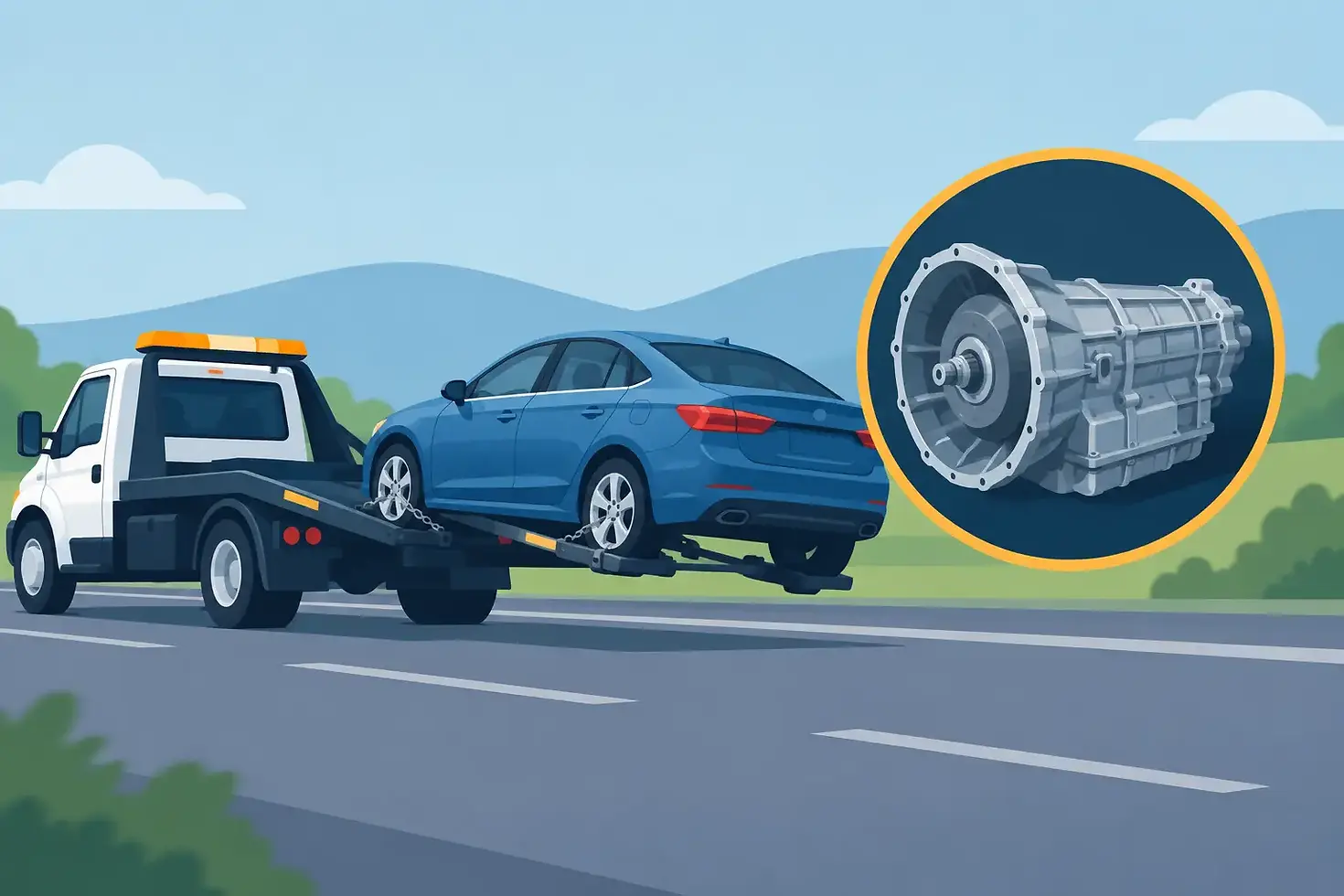
Can Towing Damage a Transmission? What to Know

A breakdown is stressful enough without worrying that the recovery process could create a second, more expensive problem. Can towing damage a transmission? Yes, it can - but damage is not inevitable. It usually happens when the vehicle is towed with the wrong wheels on the road, for too far, or without following the manufacturer’s recovery instructions.
The safest choice depends on your drivetrain, transmission type, vehicle condition, and why the car cannot be driven. A professional towing team should confirm these details before loading your vehicle, not after it is already moving.
How towing can damage a transmission
An automatic transmission relies on internal components that are lubricated while the engine is running. When a disabled vehicle is pulled with its drive wheels on the ground and the engine off, parts inside the transmission can continue turning without proper fluid circulation. Heat and friction can build up quickly, especially over longer distances or at higher towing speeds.
That can damage clutches, bearings, seals, gears, and other internal parts. The result may not always be obvious immediately. A car may seem normal after it is dropped off, then later develop slipping, rough shifting, delayed engagement, warning lights, or transmission fluid leaks.
Manual transmissions are often more tolerant of flat towing than automatics, but that does not mean every manual car can be towed the same way. Some modern vehicles have drivetrain designs, electronic parking brakes, or all-wheel-drive systems that require a specific procedure. The owner’s manual remains the final authority for a particular make and model.
Towing in neutral is not always safe
Many drivers assume that shifting into neutral protects the transmission. Neutral disconnects engine power from the driven wheels, but it does not necessarily stop all transmission components from rotating. On many automatic vehicles, the transmission pump is driven by the engine. With the engine off, the pump may not circulate fluid even though the gear selector shows neutral.
Neutral also does not solve every problem with electronic shifters, parking pawls, or a vehicle that has lost electrical power. If the car cannot be placed safely in neutral, forcing it or dragging it onto a truck can cause mechanical damage. Proper equipment, such as wheel dollies or a flatbed, is the safer answer.
Which vehicles need extra care during towing?
Front-wheel-drive, rear-wheel-drive, all-wheel-drive, hybrid, electric, and performance vehicles each have different recovery needs. The towing method must match the vehicle, not simply what is quickest to hook up.
A front-wheel-drive vehicle is commonly towed with its front wheels lifted off the ground. This prevents the drive wheels from turning. A rear-wheel-drive vehicle usually needs its rear wheels lifted, or it may require a driveshaft disconnect or removal before being pulled. Leaving the rear wheels on the road can rotate the transmission and create the same lubrication concern.
All-wheel-drive and four-wheel-drive vehicles deserve the most caution. Because all four wheels are connected through the drivetrain, towing only one axle can strain the transfer case, center differential, transmission, or other drivetrain components. In most cases, a flatbed tow keeps all four wheels off the road and is the preferred method.
Hybrid and electric vehicles may have additional restrictions because of regenerative braking systems, high-voltage components, and electronic parking brakes. Some can only be transported on a flatbed. A recovery operator should consult the manufacturer’s instructions rather than assume a conventional tow setup will work.
The vehicles most likely to need specialized handling include:
Automatic vehicles with unknown transmission damage or low fluid
All-wheel-drive and four-wheel-drive vehicles
Cars with continuously variable transmissions, also called CVTs
Hybrids and electric vehicles
Vehicles involved in accidents, especially with wheel, axle, or suspension damage
Flatbed towing is often the safest option
A flatbed tow truck carries the entire vehicle with all four wheels off the ground. Since the wheels and drivetrain are not rotating during transport, the chance of towing-related transmission damage is greatly reduced. It also avoids unnecessary wear on tires, wheel bearings, differentials, and transfer cases.
Flatbed recovery is particularly useful after an accident, when a vehicle will not shift into neutral, when a tire or suspension component is damaged, or when the drivetrain condition is unclear. It may take slightly more time to load than a simple wheel-lift tow, but it is often the safer trade-off when a transmission repair could cost far more than the recovery itself.
A wheel-lift tow can still be appropriate for certain vehicles when the correct drive wheels are raised and the vehicle manufacturer allows it. The key is not whether one method is always better. The key is using the method that is safe for your vehicle’s configuration and present condition.
Can a short tow still cause transmission damage?
Sometimes, yes. A short distance does not automatically make an unsafe method safe. A few blocks may be low risk for one vehicle and harmful for another, particularly if the transmission is already compromised, the car is in park, a wheel is locked, or the vehicle has all-wheel drive.
Distance, speed, and condition all matter. Towing a vehicle slowly for a very short distance with the correct wheels raised is different from pulling it on its drive wheels along an expressway. If the car has overheated, has a transmission warning light, has no transmission fluid, or cannot shift normally, treat it as a recovery situation that needs careful loading.
What a professional recovery operator should check
Before a vehicle is moved, the operator should ask what happened. A dead battery, flat tire, engine no-start, accident, transmission fault, or locked wheels can each change the safest approach. They should also identify the drivetrain and verify whether the vehicle can roll, steer, and be shifted into neutral.
Good recovery work is controlled from start to finish. The vehicle should be secured using suitable attachment points, loaded without excessive dragging, and transported in a way that protects the drivetrain and bodywork. If the vehicle cannot be safely handled on-site, it should be sent to a workshop for diagnosis rather than pushed into motion.
At On Site Car Accessories.sg, vehicle recovery is treated as more than getting a stranded car out of the way. The priority is safe handling, quick response, and choosing the right recovery method for the situation so a breakdown does not turn into avoidable mechanical damage.
Signs to watch for after a tow
If your vehicle was towed and you are concerned about transmission damage, do not ignore new driving symptoms. Check for transmission fluid leaks under the vehicle and pay attention to how it engages drive or reverse. A delayed response, shuddering, slipping, burning smell, unusual whining, or a transmission warning light calls for prompt inspection.
Do not continue driving a car that is slipping or struggling to shift just to see if it improves. Continued use can turn a minor issue into internal damage. A workshop can inspect fluid condition, scan for fault codes, and assess whether the issue is related to towing, the original breakdown, or a separate mechanical fault.
What to tell the towing service when you call
You can help prevent damage before the tow truck arrives. Tell the operator your vehicle make, model, year, and whether it is front-wheel drive, rear-wheel drive, all-wheel drive, or four-wheel drive if you know. Explain whether the engine starts, whether the gear selector moves into neutral, and whether any wheels are damaged or locked.
Mention any accident damage, warning lights, fluid leaks, overheating, or transmission symptoms. If you have the owner’s manual available, check the emergency towing section and share any restrictions. This information allows the recovery team to arrive with the right equipment instead of making risky assumptions at the roadside.
When your car cannot move, the fastest solution is not always the safest one. A careful tow protects the transmission, protects the rest of the drivetrain, and gives you a better chance of arriving at the workshop with only the original problem to fix.


Comments