

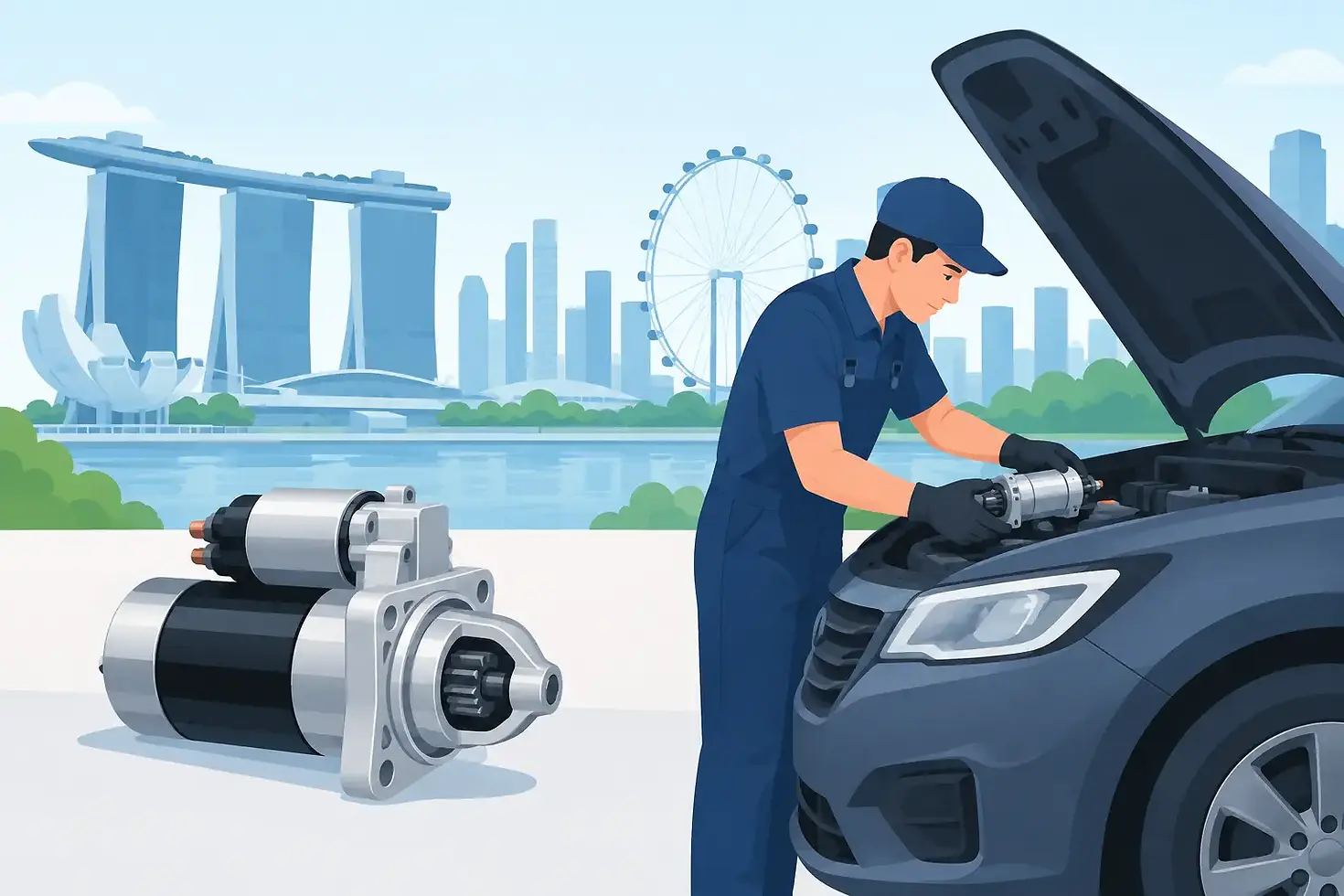
Mobile Starter Replacement Service in Singapore

Your car lights may come on, the dashboard may look normal, and yet the engine will not crank. You turn the key or press the start button and hear one click, repeated clicking, or nothing at all. When you are stuck in a carpark, outside your workplace, or on the roadside, a mobile starter replacement service can bring diagnosis and repair support directly to your location.
A no-start problem is stressful because several faults can produce similar symptoms. A weak battery, loose terminal, faulty starter motor, damaged wiring, alternator issue, immobilizer fault, or transmission safety switch may all prevent the engine from starting. Replacing parts without checking the cause can waste time and money. The right response is a prompt on-site inspection by an experienced technician who can identify whether the starter is truly the problem.
When Do You Need a Mobile Starter Replacement Service?
The starter motor is the electric motor that cranks your engine when you start the vehicle. It works with the battery, starter relay or solenoid, ignition system, and engine wiring. When the starter begins to fail, it may work intermittently before it stops working altogether.
A common sign is a single solid click when you attempt to start the car, while the lights remain bright. In other cases, the engine may crank very slowly despite a battery that has tested healthy. You may also notice a grinding noise, a whirring sound without engine cranking, smoke near the engine bay, or a burning electrical smell. These symptoms need professional attention, especially if the vehicle is in an unsafe location.
A mobile technician can assess the battery condition, battery connections, charging voltage where applicable, starter circuit, and starter operation before recommending replacement. This matters because a jumpstart may get a car moving temporarily when the battery is weak, but it will not repair a failed starter. On the other hand, fitting a new starter will not solve a battery or charging fault.
Why an On-Site Diagnosis Saves Time
Sending a non-starting car straight to a workshop is sometimes necessary, but it is not always the first step. If the issue can be confirmed and repaired at your location, you avoid arranging transport for a problem that may be resolved on the spot.
An on-site assessment is especially useful when your car is trapped in a multi-story carpark, parked at home, or stopped at an office building. These locations can make towing more complicated. A mobile mechanic can first determine whether the vehicle can be safely started, whether a replacement starter can be installed on-site, or whether recovery to a workshop is the safer choice.
Starter accessibility varies significantly by make and model. Some starter motors are located where a technician can reach them efficiently from underneath or through the engine bay. Others require removal of surrounding components, specialist tools, extended labor, or workshop lifting equipment. A dependable service should be honest about this trade-off. The priority is not to force an on-site repair, but to get your vehicle handled safely and correctly with the least disruption possible.
What Happens During a Starter Fault Call-Out?
The first step is to share your vehicle model, location, and what happens when you try to start it. If you are in a carpark, provide the parking level and lot area where possible. This helps the mobile team prepare for access and respond more efficiently.
Once on-site, the technician checks the obvious causes first. Battery voltage and terminal condition are important because corroded or loose connections can interrupt the high current required for starting. The technician may also inspect fuses, relays, starter wiring, and relevant safety switches. For automatic vehicles, the car may need to be checked in Park and Neutral. For keyless vehicles, the key fob battery and immobilizer response may also be considered.
If testing points to the starter motor, the technician will advise whether replacement is suitable at the location. A quality replacement part should be selected based on vehicle compatibility, not simply on the lowest price. The starter must have the correct fitment, gear engagement, electrical rating, and mounting points for your vehicle.
After replacement, the vehicle should be tested through multiple start cycles. The technician should also check that the engine starts cleanly and that there are no obvious wiring, charging, or warning-light concerns. A starter replacement solves the cranking issue only when the starter itself is the confirmed cause.
Do Not Keep Repeatedly Trying to Start the Car
When a vehicle will not start, it is tempting to keep pressing the ignition button or turning the key. Repeated attempts can drain the battery, overheat electrical components, and make diagnosis less clear. If you smell burning, see smoke, hear grinding, or notice damaged battery cables, stop attempting to start the car.
If your vehicle is stopped in a live traffic area, switch on hazard lights if possible and move to a safe position away from traffic. Do not work under the hood near moving vehicles or attempt to push the car in an unsafe area. Call for assistance and provide the clearest possible location details.
For a car in a basement or restricted-access carpark, mention any height limits, entry restrictions, or security procedures. This allows the responding team to bring the appropriate vehicle and equipment.
On-Site Replacement or Towing: Which Is Better?
It depends on the fault, the vehicle design, and the conditions at your location. An on-site repair is ideal when the starter is accessible, the diagnosis is clear, and the work can be completed safely without compromising quality. It can get you back on the road without the extra delay of transporting the vehicle.
Towing to a workshop is the better option when the starter is difficult to access, the vehicle has multiple electrical faults, or further diagnostic equipment is required. It is also advisable after an accident, when there is visible wiring damage, or when the car cannot be safely worked on where it is parked. A workshop can provide deeper testing and mechanical repair when a roadside fix is not appropriate.
This is why mobile support backed by a workshop is valuable. You get a fast first response and a clear next step, rather than being left to arrange separate diagnosis, transport, and repair services.
Preventing Another No-Start Situation
Starter motors can fail with age and mileage, but basic maintenance helps reduce avoidable starting problems. Keep battery terminals clean and secure, address slow cranking early, and do not ignore intermittent clicking sounds. If the battery warning light appears while driving, arrange a charging-system check before the battery becomes too weak to start the engine.
Short trips, long periods without driving, and Singapore's heat can put extra strain on vehicle batteries and electrical systems. A battery check is worthwhile if your car is cranking more slowly than usual. However, do not assume every starting problem is the battery. A proper diagnosis protects you from replacing the wrong component.
When your car will not start, fast help matters, but accurate repair matters just as much. On Site Car Accessories.sg provides 24/7 mobile assistance for drivers who need prompt diagnosis, starter replacement support, jumpstarts, towing, and workshop backup when the problem requires more than an on-site repair. Call or WhatsApp with your location, vehicle details, and symptoms so the right help can be arranged without delay.


Comments